Arc De Triomphe

Why visit
You can lower it on your list if you dislike stair climbs, since the roof means 284 steps, or if you are mainly after interior museum-style content rather than a viewpoint and memorial. For most travelers, this is worth doing once if the rooftop view matters to you; book the roof ticket online and treat it as a focused evening stop rather than a long visit.
What to know beforehand
[ { "editorial_notes": "The Arc de Triomphe works best for visitors who want one strong, efficient stop: a major Paris landmark, a clear sense of the city’s grand layout, and a very good rooftop view without committing half a day.
In practice, the main constraint is physical rather than cultural: the 284-step climb is real, and the visit feels less rewarding if you are expecting a long interior museum or a quiet monument.
The most practical approach is to come for the roof and treat the memorial level, reliefs, and eternal flame as part of the same short visit.\n\nGood fit: first-time visitors, photographers, and anyone choosing between several viewpoints and wanting a central, classic Paris panorama.
More likely to feel underwhelmed: travelers who dislike stairs, want seating and lingering comfort, or expect an immersive historical site rather than a compact monument with a terrace on top.
The detail many people miss is that access is via the underground passage only, so this is not a place to improvise from the traffic circle itself.\n\nPro Tip: Access the monument only via the underground Passage du Souvenir to avoid the dangerous traffic circle.", "summary": "The Arc de Triomphe is not only a recognizable Parisian monument but also a strategic point to grasp the scale of the city.
From the roof, the layout of the 12 avenues is perfectly visible, while the ground level focuses on military memory, reliefs, and the urban rhythm of the Champs-Élysées. It is ideal for those wanting to combine a symbolic site with a powerful panorama, especially toward the evening.
Just keep in mind the 284-step climb and the typically high visitor numbers.", "body": "- Essence — Napoleonic monument at Place de l'Étoile: visited for the 360° panorama of 12 avenues, the military memorial, and a quick visit.\n- Price — Roof access is €16; free for those under 18 and EU residents aged 18–25.
Ground-level viewing, reliefs, and the Eternal Flame are free.\n- Time — Allow 1–1.5 hours; the best slot is an hour before sunset, and there are fewer people after 20:00.\n- How to get there — Metro Charles de Gaulle – Étoile: Lines 1, 2, 6, and RER A; entry is strictly via the underground passage.\n- Nuance — There are 284 steps to the roof; no elevator is available except for disabled access to the intermediate level upon request.\n- Booking — Purchase tickets online: the ticket office takes 15–30 minutes; the Paris Museum Pass covers the roof and provides priority access.", "best_time": "Evening (one hour before sunset)", "ticket_block": "### Which ticket to choose\n\nFor a first visit, a standard roof ticket is sufficient: it grants access to the interior of the monument, a small museum, and the terrace overlooking the 12 avenues of Place Charles de Gaulle.
This is a straightforward 1–1.5 hour format without the need for expensive packages.\n\nIt makes sense to pay extra for convenience rather than \"VIP\" status: an online ticket saves time at the box office, and the Paris Museum Pass is cost-effective if you plan to visit the Louvre, Orsay, Sainte-Chapelle, Panthéon, Invalides, or Versailles during the same trip.
There is no \"secret\" elevator for general visitors; the 284 steps are the only way up, as the elevator is reserved for those with mobility needs.\n\n- If you only want the Paris panorama — get a standard roof ticket.\n- If you are only viewing the arch from the outside, the reliefs, and the Eternal Flame — no ticket is required.\n- If you plan to visit several museums and monuments over 2–4 days — get the Paris Museum Pass.\n- If you see \"fast-track\" offers from third parties — remember that security checks remain mandatory for everyone.\n\nImportant: A common mistake is trying to enter by crossing the traffic circle.
Crossing the square at street level is prohibited; access to the arch is only through the underground Passage du Souvenir from the Champs-Élysées or Avenue de la Grande-Armée.", "timing_block": "### Best time to visit\n\nThe best time for the roof is approximately one hour before sunset: the city is still visible in detail, then the Champs-Élysées, the Eiffel Tower, and the radial avenues light up.
This is the most beautiful but also the most popular slot, so allow time for entry and the climb.\n\nFor a quieter visit, choose the morning right after opening or late evening after 20:00.
Mornings are more comfortable for families and there is less competition for a spot at the parapet; evenings offer a stronger atmosphere and better photos of the lights, though the flow on the stairs and observation deck is denser.\n\nAdvice: Photographers should aim for sunset, families for the morning, and solo travelers for the evening, when the visit can be easily paired with a walk along the Champs-Élysées.", "combos_discounts": "### Combos and discounts\n\nThe most logical way to save is not through random combos, but via the Paris Museum Pass if you are visiting multiple paid sites.
The Arc is included in the pass, no separate time slot reservation is required, and entry follows the line for pass holders and online ticket holders.\n\nA practical combined option is the \"Arc de Triomphe Roof + Seine Cruise\" package.
It is convenient if you want to cover two classic Parisian views in one day: the city from above at Place de l'Étoile and then from the water.
Financially, this combo is not always cheaper than separate tickets, so it is primarily worth it for the convenience of a single booking.\n\nFree roof access is available for visitors under 18, as well as for EU citizens and legal residents aged 18–25.
Viewing the arch from below, the reliefs, the Tomb of the Unknown Soldier, and the Eternal Flame is free for everyone.", "tours_block": "### When a tour makes sense\n\nA guide is useful if you want to understand the arch as part of French military and political history: Napoleon, the names of battles on the walls, the sculptural groups, the Eternal Flame ceremony, and the logic behind Place de l'Étoile.
A good format is not a standalone tour of just the arch, but a walk along the Champs-Élysées ending at the roof.\n\nSelf-guided visits are sufficient if your main goal is the panorama and photography.
The monument is compact, the route inside is simple, and the museum section does not require lengthy explanations; in this case, it is better to spend your budget on a Paris Museum Pass or a Seine cruise.", "prime_timing": "Best time to climb: Weekdays 10:00–11:00 or after 19:00 (for sunset).
Busiest hours: 14:00–17:00, especially on weekends. Bastille Day features a military parade on the Champs-Élysées; the arch is closed for visits but offers a spectacular sight. New Year's Eve sees massive crowds at the arch. The cooler months typically see fewer tourists.
A night visit (21:00–22:30) provides one of the best views in Paris with the 12 illuminated avenues." } ]
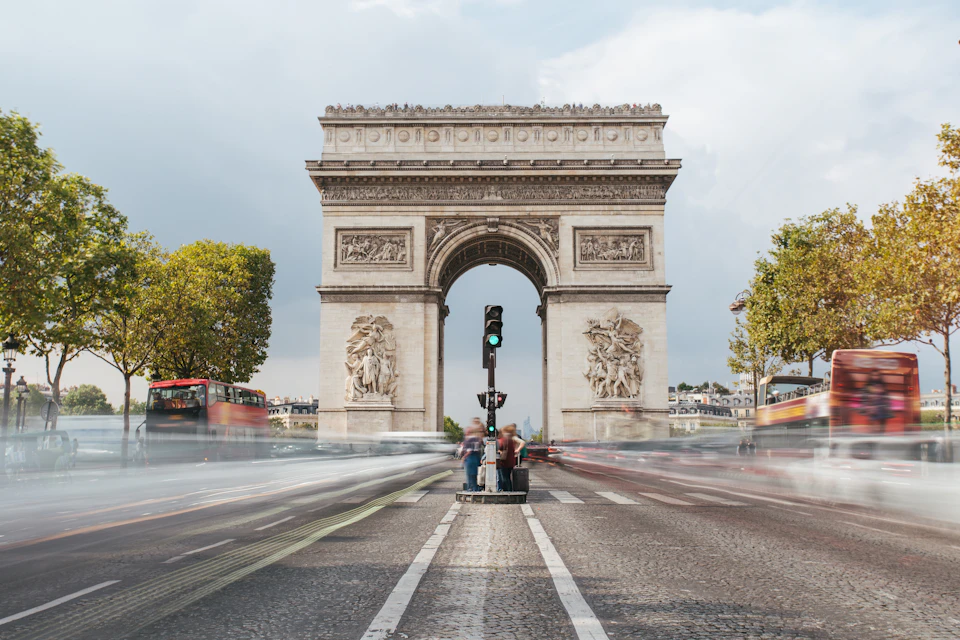

🎫 Tickets, tours & discounts
Arc de Triomphe Rooftop Ticket (Entry Ticket)
- Admission to the Arc de Triomphe interior
- Access to the rooftop terrace viewpoint
- Small museum and exhibition inside the monument
- Climb of 284 steps to the terrace
Arc de Triomphe Reserved Entrance with Rooftop Access
- Pre-booked admission to the monument
- Rooftop terrace access above Place Charles de Gaulle
- Security check still required on arrival
- Lift access only for visitors who need it
Paris Museum Pass including Arc de Triomphe
- Valid for 2, 4, or 6 consecutive days
- Includes Arc de Triomphe rooftop access
- Also covers Louvre, Orsay, Panthéon, and Sainte-Chapelle
- Does not include guided tours or temporary extras
Arc de Triomphe Rooftop Ticket and Seine River Cruise Combo
- Arc de Triomphe rooftop admission
- One-hour Seine River sightseeing cruise
- Cruise audio commentary or app commentary
- Flexible cruise boarding depending on operator
Which ticket to choose
For most visitors, the basic rooftop ticket is enough: it gets you inside the monument, through the small exhibition level, and up to the terrace for the 360-degree view over the 12 avenues radiating from Place Charles de Gaulle. Standard adult entry starts at €16, with a higher €22 fare on high-demand Wednesdays in the longer-hours season.
Paying more only makes sense if the product clearly saves you a ticket-office queue, bundles a Seine cruise you already planned to take, or includes a real guided explanation rather than just resale of the same entry ticket. The view is the main attraction, so there is no need for a “VIP” upgrade unless it solves a practical problem in your itinerary.
- Basic rooftop ticket: best for first-time visitors, couples, solo travelers, and anyone mainly coming for the view.
- Paris Museum Pass: best if you are also visiting paid museums or monuments such as the Louvre, Musée d’Orsay, Sainte-Chapelle, Panthéon, or Versailles.
- Combo ticket: useful only when the second activity, especially a Seine cruise, already fits your day.
- Ground-level visit: free, and enough if you only want the reliefs, the Eternal Flame, and photos from the base.
Best time to go
The strongest slot is about one hour before sunset. You get daylight for the avenues, golden-hour photos over the Champs-Élysées, and the first lights of Paris from the terrace if you stay long enough. This is also the busiest and least comfortable time on the stairs and rooftop.
For a calmer visit, go in the morning or after 20:00. Morning is better for families and anyone who wants less crowd pressure on the 284-step climb; later evening is better for couples and solo travelers who care more about atmosphere than crisp daylight photos.
Solo visitors should choose late evening for the smoothest short visit. Families should aim for the morning and avoid arriving tired after a full museum day. Photographers should prioritize the sunset slot and accept the crowd trade-off.
Combos and discounts
The most reliable money-saving route is not a flashy combo but the right eligibility. Entry is free for visitors under 18, for EU nationals and qualifying residents aged 18–25, for disabled visitors with one accompanying adult, and on selected first Sundays in the low season.
The Paris Museum Pass covers rooftop access and is worth considering when you plan several included museums and monuments in a tight schedule.
Real combo tickets commonly pair Arc de Triomphe rooftop access with a Seine River cruise, and some platforms also package it with Eiffel Tower experiences. These are convenient when you want one checkout and a simple sightseeing day, but they are not automatically cheaper than buying separately.
Compare the total only if you genuinely want every item in the bundle.
When a tour makes sense
A guided tour is worth it if you want the monument to be more than a viewpoint. A good guide connects Napoleon’s commission, the military reliefs, the Tomb of the Unknown Soldier, the Eternal Flame, and the urban design of the Étoile in a way that is hard to piece together during a quick climb.
Skip the tour if your goal is mainly the panorama, photos, and a compact one-hour stop. The self-guided visit is straightforward: enter via the underground passage, climb to the exhibition level, continue to the terrace, then leave time at ground level for the memorial and sculptures.

Crowd indicator
Crowds peak heavily around sunset and on weekends, while mornings offer a much calmer climb up the 284 steps.
Mini-calculator based on crowd levels by day and time.
This day has average visitor density. This slot has a higher chance of a comfortable visit: Calmest time for the stair climb. Weather is currently not ideal: overcast ☁️.
Nearest days

How to get there
How to find the entrance
Address: Place Charles de Gaulle, 75008 Paris. Use Charles de Gaulle–Etoile station on metro lines 1, 2, 6 or RER A. The key point: do not try to cross the traffic circle at street level. The entrance is reached through the underground pedestrian passage.
Once you come up inside the monument area, expect the visit to split into two parts: the free ground-level area with the reliefs and Eternal Flame, and the paid rooftop access. Rooftop tickets cost EUR 16; entry is free for under-18s and for EU residents aged 18-25. The Paris Museum Pass covers rooftop access and gives priority entry.
The main time loss is not finding the monument, but the queue process: ticket purchase, security, and the staircase flow. Buying online saves about 15-30 minutes at the ticket desk. Allow 1-1.5 hours for the full visit, and arrive about an hour before sunset if you want the strongest view; after 20:00 the crowd is lighter.

Practical limits & what to bring
What to consider before visiting
The Arc de Triomphe is a short visit, but it is not a friction-free one: expect entrance security, a compact interior, and queues that build around sunset. Use the underground passage from Charles de Gaulle – Étoile; do not try to cross the traffic circle at street level.
The roof is reached by 284 steps, so this is a poor choice if stairs are a problem. The lift is not part of the standard visitor route and is reserved for visitors who need assistance; there is no special dress code and no minimum age, but children need close supervision on the stairs and terrace.
What you can and cannot bring
- Small bags are allowed after security screening if they fit within the size limit.
- A small backpack is fine if it stays within 40 x 40 x 20 cm.
- Non-glass water bottles are the practical choice; glass bottles are not allowed.
- Eating is not allowed inside the monument or on the terrace.
- Flags and banners are not allowed.
- Selfie sticks are not allowed.
- Tripods are not allowed.
- Scooters, rollerblades, skateboards, and similar wheeled items are not allowed.
- Sharp objects are not allowed.
- Weapons are not allowed.
- Aerosols are not allowed.
- Motorcycle helmets are not allowed.
- Large luggage and oversized bags are not allowed.
Lockers and belongings
There are no lockers, cloakroom, or left-luggage facilities at the Arc de Triomphe. Bring only what you can carry through security and up the stairs; luggage over 40 x 40 x 20 cm should be left at your hotel or a city luggage-storage point before you arrive.
Strollers are not allowed inside the monument. You can leave a stroller with the access-control staff and collect it after the visit, but do not treat this as a full baggage service: valuables and extra bags should stay with you or be left elsewhere.

Location and what's nearby
What kind of district
- This is monumental Paris: broad avenues, formal facades, flagship shops, luxury hotels, and heavy traffic around Place Charles de Gaulle.
- It suits a compact first-timer day: panorama, Champs-Elysees, designer windows, and a polished dinner without crossing the city.
- The mood changes by block: tourist-heavy on Champs-Elysees, calmer and more residential toward Ternes, Rue Poncelet, and Avenue Foch.
- Families can do it, but the area is better for confident walkers than slow wandering; crossings, crowds, and wide roads shape the visit.
Nearby on foot (up to 15 minutes)
- Champs-Elysees — classic Paris avenue for shops, cinemas, and people-watching · 3 min
- Avenue Foch — grand residential avenue with a long green central promenade · 5 min
- Place des Ternes — local square with cafes, shops, and neighborhood traffic · 7 min
- Rue Poncelet — lively market street for cheese, produce, and bakeries · 10 min
- Salle Pleyel — landmark concert hall with strong Art Deco presence · 10 min
- Saint-Alexandre-Nevsky Cathedral — unexpected Russian Orthodox architecture in a quiet side street · 12 min
- Avenue Montaigne — couture houses and polished window-shopping near the Golden Triangle · 15 min
- Musee Guimet — major Asian art museum in an elegant 16th arrondissement setting · 15 min
15-30 minutes by transport
- Trocadero — direct Eiffel Tower viewpoint after the Arc rooftop · 10 min by taxi
- Petit Palais — free permanent collection in a Belle Epoque landmark · 15 min by taxi
- Grand Palais — major exhibitions and monumental glass-roof architecture · 15 min by taxi
- Place de la Concorde — historic square linking Champs-Elysees and Tuileries · 15 min by metro
- Palais Garnier — ornate opera house for a stronger Belle Epoque pairing · 20 min by metro
- Louvre Museum — big-ticket museum finish after the ceremonial west-east axis · 20 min by metro
Where to eat nearby
- L'Oiseau Blanc — rooftop French fine dining with Eiffel Tower views · expensive · booking essential · 8 min on foot
- Le Hide — French bistro cooking with Japanese precision · mid-range · worth booking · 5 min on foot
- Matsuhisa Paris — Japanese-Peruvian dining at Le Royal Monceau · expensive · booking essential · 7 min on foot
- Le Relais de l'Entrecote — steak-frites and fixed-formula Paris ritual · mid-range · walk-ins possible · 15 min on foot
- Publicis Drugstore — polished brasserie beside the Champs-Elysees · above average · worth booking · 3 min on foot
Ready-made day route
Start with the Arc de Triomphe rooftop, then walk the Champs-Elysees side rather than circling the traffic-heavy square. Continue toward Rue Poncelet for a more local contrast, add Saint-Alexandre-Nevsky Cathedral or Salle Pleyel, then return for dinner at Le Hide.
If you want the more cinematic version, swap the market-street detour for Avenue Montaigne and finish at L'Oiseau Blanc.

ReferenceFacts
Read more
Numbers and Scale
- Height: 49.54 m tall, 44.82 m long, and 22.21 m deep; it dominates Place Charles de Gaulle without needing a tower.
- Main vault: 29.42 m high; that void is large enough to frame the Champs-Elysees axis from street level.
- Stair count: 284 steps to the terrace; the rooftop view is a real climb, not a quick lift ride.
- Star layout: 12 avenues radiate from the roundabout; the terrace makes Paris’s urban geometry instantly readable.
- Inscriptions: 660 military names and 158 battles are carved into the monument; it works as a stone military archive.
- Materials: 36,695 m3 of stone and rubble plus 128,000 kg of metal; the arch is far heavier than its clean silhouette suggests.
- Build span: first stone laid on 15 August 1806, inaugurated on 29 July 1836; the project outlived Napoleon’s reign.
Myths and Misconceptions
- Myth: Napoleon is buried beneath the arch. In fact: His remains rest at Les Invalides; the tomb here is the Unknown Soldier.
- Myth: Napoleon watched the finished monument open. In fact: He died before completion; the arch opened under King Louis-Philippe.
- Myth: The traffic circle is crossed on foot. In fact: Pedestrians use the underground Passage du Souvenir from the surrounding avenues.
- Myth: It stands on Place de la Concorde. In fact: The arch stands on Place Charles de Gaulle, formerly Place de l'Etoile.
- Myth: The arch commemorates only Napoleon personally. In fact: It honors armies of the Revolution and the First Empire.
Rare and Unusual
- In 1758, Ribart de Chamoust proposed a giant elephant monument on this site, topped by a statue of Louis XV.
- In 1810, Napoleon and Marie-Louise passed under a full-size wood-and-painted-cloth model before the stone arch existed.
- The rooftop once had a temporary quadriga by Alexandre Falguiere; the plaster-and-frame group stood from 1882 to 1886.
- Charles Godefroy flew a Nieuport biplane through the main arch on 7 August 1919, after studying the air currents.
- The Unknown Soldier was chosen at Verdun from eight coffins; Auguste Thin selected the sixth by placing flowers on it.
- The Flame of Remembrance is rekindled every evening at 18:30, a ritual run by veterans’ associations beneath the arch.
BackgroundHistory
Read more
Why it matters
The Arc de Triomphe was conceived as a victory monument: Napoleon ordered it after a major military triumph to honor the French army, and its scale was meant to match the grandeur of the new imperial capital.
Even if you do not follow military history, that ambition is still easy to read on site — in the massive proportions, the carved battle scenes, and the commanding position at the top of the Champs-Élysées.
What gives the monument its deeper weight today is that it became more than a triumphal arch. Beneath it lies the Tomb of the Unknown Soldier, and the eternal flame turned the site into one of France’s central places of national remembrance. That is why a visit feels split between two experiences: a memorial at street level, and a panoramic viewpoint above.
For visitors, that contrast is the real reason to come. The roof shows how Paris was planned around the great star-shaped junction, while the base explains why the monument carries such symbolic force for France itself. It is not just a photo stop on a famous avenue; it is where imperial spectacle, civic memory, and the geometry of Paris meet in one place.

♿ Accessibility & families
Accessibility & family policy
- Wheelchair users / reduced mobility: The Arc de Triomphe has lift access to the museum level and the panoramic terrace, so the main interior visit and the view are accessible without doing the full 284-step climb. There is an accessible toilet, seating on all levels, and wheelchairs are available on site. One important limit: the mezzanine is not accessible, and the first lift has a 75 cm door, which can be tight for some larger chairs.
- Arrival matters: The pedestrian underpass used by most visitors is not accessible for wheelchair users. Step-free access to the monument forecourt is via the drop-off point on the Avenue de la Grande Armée side, by taxi or private car.
- Strollers and young children: Strollers are not allowed inside the monument, but staff will hold them at the entrance and you collect them after the visit. Families with young children can use the elevator instead of taking the stairs. There is a baby-changing table in the toilet.
- Family rules and comfort: Children under 18 enter free. The visit is manageable with children, but the site is less convenient with a buggy because you cannot keep the stroller with you. For older visitors and families, the main friction points are the busy traffic setting around the monument, the access procedure, and the 284 steps for anyone not using the lift.
🏢 On-site amenities
- Restrooms: Toilets are inside the monument, in the museum hall on the visitor route. They are not a separate paid service. Accessible toilets are available there, and the restrooms also have a baby-changing table.
- Cafe / restaurant: There is no café or restaurant inside the Arc de Triomphe. The on-site shop does not sell food or drinks, and eating in the monument or on the terrace is not permitted.
- Gift shop: Yes — there is a bookshop-boutique inside, in the museum hall along the visit route. It is a standard museum shop selling magnets, postcards, books about the Arc de Triomphe, crockery, and other souvenirs.
- Water / family facilities: You can bring your own water bottle; glass bottles are prohibited. For families, strollers are not allowed inside, but they can be left with access control staff and collected after the visit. The monument confirms baby-changing facilities in the restrooms.
